1680-1709 TAYLOR John

1680-1709 TAYLOR John
YORKCLICK the (For local directory of sugar houses, click here.) (For national directory of sugar houses, click here.)
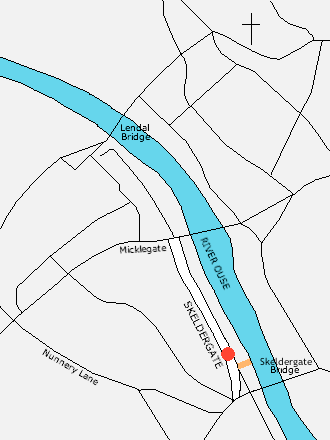
The width of this map represents 0.5ml / 0.8km. |
|
**************************************
|
|
| before 1719 | after 1721 |
|
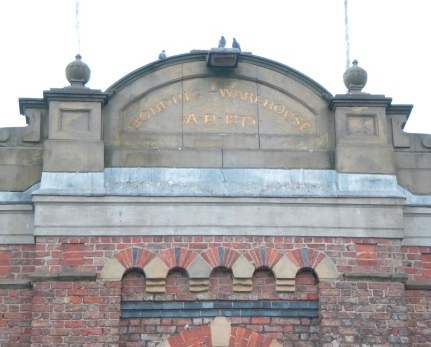
In 1972, a trial trench on this site, immediately north of the Bonding Warehouse, provided pottery from post-medieval levels that was later recognised as being sugar moulds and syrup jars associated with a sugarhouse. Lime and white clay ... both were essential ingredients for the early sugar refining process, and both were found during the follow-up excavations by YAT archaeologists in 1983. Each trench was over a 'room' about 5m wide (N to S) that stretched almost 25m between Skeldergate and the river wall ... indeed the eastern walls sat upon the old river wall. There were dividing walls across the width. In his unpublished report, Arthur MacGregor, the YAT archaeologist responsible for the earlier 1972 dig that uncovered the sugar pottery and prompted further excavation, speculated that with each 'room' just one pole wide, 4 'rooms' would make a unit of approx 22m (4 poles) being the width of the old medieval tenements in that part of York. So the Dutch-gabled warehouses took up just one of these 4 pole units, and the 1891 OS map shows the site to the north measuring a further 3 units to a return in the river wall and the Bonding Warehouse (1875) to the south measuring 2 units. I'm unsure of the size of the earlier sugarhouse for the evidence from the dig shows it certainly used the southern half (2 poles) of the area covered later by the Dutch-gabled warehouses, but no trenches were dug in the other half. Just 11m would have been enough for a small sugarhouse even including dwelling space ... the Pawson deeds' summary refers to "a house and premises near the Crane". John Taylor obtained the property in two batches but I don't know if this meant 2x5m or 2x11m. John Taylor, a prominent Quaker, was imprisoned for his religious beliefs at least four times, sailed back and forth across the Atlantic five times and on one occassion lost his ship with his slaves, refined sugar in Barbados and appears to have eventually settled in York to refine sugar there in 1680. Four years earlier he had left instructions with a Friend, Edward Nightingale, to find a house for him in which he could start his business. This he obtained on 1st October 1680 and Taylor became the first, and only, cane sugar refiner in the history of York. He refused to take an oath to become a Freeman of the City, a necessity for trading in York, and not until 1681 did both parties eventually climb down and Taylor paid a reduced fine. This was the year he obtained part of the property on Skeldergate, and he obtained the rest in 1690. Unfortunately, all his notes regarding his business were excluded from his memoirs when they were published in 1710 and again in 1830, and as yet I've found no other source. John Taylor died early in 1709 and the property was left to his family. I'm unsure whether the business continued. However, by 1719 both his wife and his only surviving son had died and the property was held by his granddaughter, Frances Falconer, who disposed of it to Henry Pawson, the builder of the Dutch-gabled warehouses. |
|
| 1718 - Robinson (YAT) |
|
|
|
| 1721 - Buck | 1735 - Anon | 1745 - Buck & Buck |
|
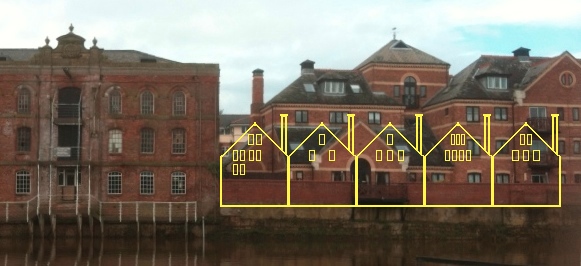
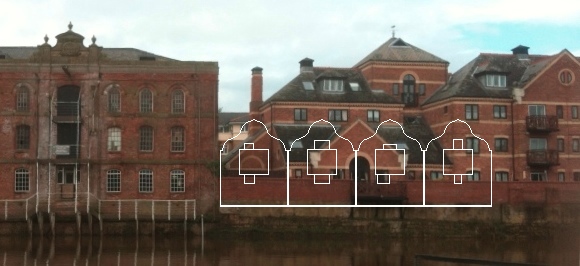
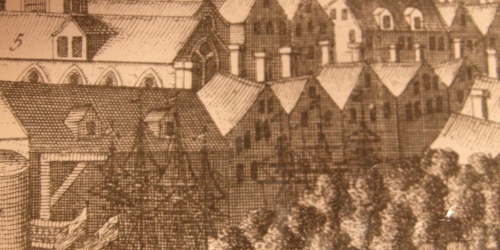
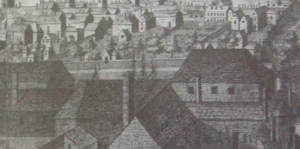
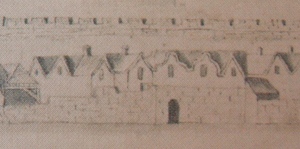
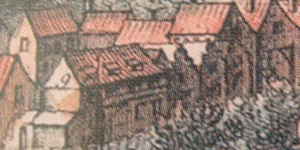
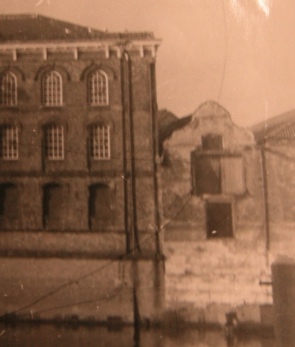
Only one representation of the area around The Crane at the lower end of Skeldergate, dated prior to the property transfer between Falconer and Pawson, has come to light so far ... the 1718 etching by Tancred Robinson. It shows a line of 5 pointed-gabled warehouses each with a number of small windows and more than one storey. These seem correct for the use of refining sugar - a process that required considerable heat from open fires and stoves at most times - as a number of shallow floors were easier to keep to temperature and tiny windows allowed some light whilst minimising heat loss. There is just too much difference between Robinson's warehouses and those photographed 135 years later by William Pumphrey (York Images, see research) for them to have been the same buildings. MacGregor wondered whether the shape of the gables may have been artistic licence, but why would Robinson, a physician and naturalist practised in studying and recording items in great detail, not draw what he saw, especially given the detail in the buildings beyond ? The archaeology and the images point to Taylor's sugarhouse and Pawson's noble vaults being totally separate and very different buildings, albeit on the same footprint. The two businesses had very different requirements for their premises, and it seems certain that the sugarhouse was demolished in 1719-20, and the wine cellars built soon after. |
|
|
| 1875 | 1950s? (YAT) |
|
[My thanks to the staff, both past and present, of the York Archaeological Trust, and the staff of the York City Archives, for their invaluable assistance with this research.] [Since completing this report, I have studied the 1710 (Sowle) edition of Taylor's Memoir. It is considerably less detailed than the 1830 (Alexander) edition. So Alexander had access to the original memoir with all the sugar trade info in it ... I wonder where it is now ?] |
|
Research Notes and Sources ...
* Buildings, Skeldergate - west bank of R Ouse, immediately above Skeldergate Bridge - a) A sugarhouse, possibly 1670s to 1730. * Chronology of Evidence (at April 2012) - ? - "Amongst the Friends penalized in York during the 17th century [was] ... John Taylor, a prominent Friend who settled in York as a sugar refiner." [Protestant Nonconformity, VCH City of York, 1961] 1680/1 - John Taylor, sugar refiner, made Freeman of the City of York. [YCA Freeman's Lists] 1690 - "Further research in connection with the sugar-refining pottery from an excavation on Skeldergate in 1972 (YAT Interim 8/4 1982) has yielded some interesting results. Work by Sarah Croney, the Trust's historian, has revealed the existence of a sugar-refiner named John Taylor, who leased a property on this part of Skeldergate for 19 years until his death in 1709. This neat tying-up of historical and archaeological evidence, the former giving a precise date to the latter, is too rarely encountered in pottery studies." [Catherine Brooks, YAT Interim 9/2, 1983 - unreferenced] 1708 - John Taylor signed his will 15 November. [Borthwick Institute York Prob Reg 65 fo.209] 1709 - John Taylor's will proved 15 April, mentioning his occupation - sugar refiner, his house in Skeldergate, his wife Elizabeth, son Isaac, late son Jonathan and his daughter, and a friend Thomas Hammond bookseller. [Borthwick Institute York Prob Reg 65 fo.209] 1730 - "... the demolition of Mr Taylor's refinery in 1730." [Colin Briden, YAT Interim 9/3 - unreferenced] 1875 - The Bonding Warehouse - "The property comprises a part four storey, part two storey brick built Grade II listed former bonded warehouse (erected 1875). The property comprises a north building and a south building and its last use was as a nightclub and restaurant." [Eddisons, File Ref. 720.2959a. (their website 2012) - unreferenced] 1970 - "The old [Dutch-gabled] warehouse, Skeldergate is of the 17th century ... probably for a wine merchant ... a modern warehouse has been built against the N. side. A late 19th century bonded warehouse adjoins the E. half of the S. elevation. Demolished in 1970." ['Inventory of the Historical Monuments in the City of York', Vol III, RCHM. HMSO, 1972 - unreferenced] 1972 - "... from post-medieval levels on a site on Skeldergate excavated in 1972 have come a large number of vessels now seen to be connected with sugar-refining, indicating that an industry important to York today has quite a long history here. The two vessel forms represented are sugar-cone moulds and jars." [Cathy Brooks, YAT Interim 8/4, 1982] 1983 - "As excavation on the two adjacent sites at the south end of Skeldergate draws to an end, a review can be given of the very impressive results obtained from these excavations. On the first site immediately to the north of the Bonding Warehouse, [grid ref: SE60315135], two trenches were laid down through areas straddling the Trust's 1972 excavation (Interim 1/1). ... The purpose of our excavation eleven years later was to see something of a sugar refinery known to have existed here in the late 17th century ... . The basic outline of Taylor's refinery was clear to us although many of the detailed arrangements had been destroyed by later building. One large furnace was excavated, and rooms containing quantities of lime - used in the process - were recorded. Of particular interest to us, however, was the fact that the builders of the refinery had placed their rear building line along the top of the 14th century river wall." [Colin Briden, YAT Interim 9/3 - unreferenced] 1995 - "The greatest losses have been the late C17 Dutch gabled warehouses, ..." ['Yorkshire: York and the East Riding' Nikolaus Pevsner, 2nd edition] 2002 - "On a site adjacent to the Bonding Warehouse excavations in 1972 and 1983 uncovered the foundations of a 17th century sugar refinery whose rear wall was on the line of the 14th century river wall. A large furnace was excavated, together with rooms containing quantities of lime used in the refining process. Remains of the distinctive cone-shaped earthenware vessels used in the process were also found (YAT site code 1983.25; Interim 8/4, 43-5, 9/2, 28-30, 9/3, 6-9; YAT 1999, 36-7). The site was aquired in 1690 by John Taylor, a wealthy and influential Quaker who, after some years resident in America and the West Indies, had settled in York as a sugar refiner in the 1670s. The raw molasses was shipped to York from the West Indies and refined here until Taylor's death in 1709." ['The Fairest Arch in England', Barbara Wilson & Frances Mee, YAT 2002 - unreferenced] * Observations - Far too much of this 'evidence' has not been referenced. Whilst Sarah Croney's main facts have simply been copied from one author to another, little gems like "Taylor in America and West Indies" and "sugarhouse demolished in 1730" just hang there, unsubstantiated. I find it interesting that E Ridsdale Tate in the early 1900s made a conjectural sketch of this exact section of riverside c1700 showing the Dutch-gabled warehouse with, abutting its south wall, a three storey building with crane and watergate ... the 1852 OS map shows it as The Old Crane. Did this building make way for the bonded warehouse ? ['The Fairest Arch in England' - above] Catherine Brooks, in YAT Iterim 9/2 p30 prior to the 1983 dig, questions whether the sugarhouse would have been totally destroyed by the building of the 18th century warehouses ! After all those weeks of digging in 1983, there appears to have been no official, detailed report published - just the notes in Interim. Where are the records - the notes, the measurements, the photographs ? * Questions for further research - 1) If John Taylor became a Freeman in 1680/1 following an apprenticeship (7 years) to a sugar refiner, it implies there was a sugarhouse in York back to the early 1670s. Did he actually lease the established sugarhouse in which he had previously trained and worked, and if so, who ran it before him ? 2) The same Freeman's List shows Taylor's son Isaac becoming a Freeman (merchant taylor) in 1705, suggesting he was born about 1684. He had an elder brother, so just when did John Taylor travel to America and the West Indies ? 3) What were the dimensions of the sugarhouse ? Did the archaeologists record them ? 4) What was the building that replaced the sugarhouse in 1730(?), and when was it demolished ? 5) My assumption had been that the sugarhouse sat between the Dutch-gabled warehouse and the north line of the bonded warehouse, yet the RCHM book (above) states that the Dutch-gabled warehouse and the bonded warehouse touched at the river wall. The archaeologists did not dig beneath the bonded warehouse, so how could the sugarhouse (demolished c1730) be beneath the 17th century Dutch-gabled warehouse ? ... unless, of course, it wasn't 17th century ! |
|
| ??? |
|
* The research continues (later 2012) - Ailsa Mainman of YAT assures me there is an archive for the 1983 dig, but a lack of funding means there has not yet been the opportunity for a full report. It appears I'm only privy to published material. My query on the Rootsweb's York Mailing List regarding the positioning of the buildings has provided two excellent replies from York folk ...
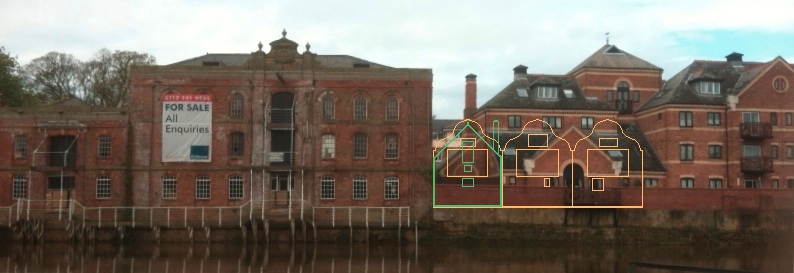
... no room then for the sugarhouse between the warehouses, confirming my notional image above. So the Dutch-gabled warehouse must have been built after the sugarhouse was demolished, therefore 18th century but perhaps 17th century in style. * - and regarding John Taylor - A chat at the recent York Family History Fair (June 2012) has resulted in some excellent info sent me by Bobbie Bateman of the City of York FHS for which I'm very grateful ... and I've added further research (April 2013). - John Taylor was born in 1638 (by 1663 his father of the same name was living in Huntingdonshire, though I don't know if this location is relevant to young John's birth). [The above are mostly notes from John Taylor's Memoir, 1830 ed. The minutes of a Quaker meeting in York, 2 Sep 1709, show that the Quarterly Meeting considered Taylor's journal/manuscript for publication but "... the latter part of the manuscript contained many observations about trade, and a Committee of the Quarterly Meeting was appointed to revise and abbreviate it." ... and they edited out the lot !!!! Some 100 copies were printed in 1710, with a later printing in 1830.] ... so cane sugar refining appears to have begun in York around 1680 and probably ended with John Taylor's death in 1709, unless of course his son or wife continued to fund the business beyond this date. Just the one business, run by Taylor, but no indication of the location prior to 1690. Taylor's freedom was by oath rather than apprenticeship, which makes more sense with respect to his age, and it looks as though he brought the skills for the trade with him from the West Indies. * The research continues (Feb 2013) - York City Archives have found an 'Abstract of Title Deeds' under the previously mentioned Acc 203 referring to the premises we know to be the sugarhouse, but not mentioning it by that name. The undated Abstract refers to six properties belonging to William and Samuel Pawson, I think, just prior to 1730 ... "An Abstract of the Title Deeds relating to the Estates of Mr William Pawson situate in the City of York, and in Stillingfleet in the County of York Mortged by him and Mr Samuel Pawson his son to Miss Belts for Eight Hundred Pounds and Interest ..." [Item 4] "As to a House and Premes near the Crane So John Taylor was living and refining in Skeldergate from at least 1681 ... the same year he was fined for carrying out a business without being a freeman of the City. I wonder if it's to do with this that the premises was first purchased by his, at that time, close Quaker friend Edward Nightingale in 1680 and then sold on to Taylor six months later. Within a couple of years Nightingale and Taylor would be in serious opposition regarding a Quaker marriage ordinance. * York (Apr 2013) - I've added further notes regarding John Taylor (from his 'Memoir' at the York Minster Library). A search of the City Library and secondhand book shops produced a whole series of paintings, sketches, photographs, notes and maps dating from 1745 to the present. Nothing early enough to solve problems of location ... but Nathaniel Whittock's 1858 Bird's-eye View of York is hugely impressive and a joy to study in detail. * In response to York visit (May 2013) - Made contact with Colin Briden who managed the 1983 YAT dig. It's too far back for him to be certain, and so he suggests I read the field report at YAT, but he has the recollection that Taylor's refinery and the Dutch gabled warehouse were one and the same thing. That had not been something I'd considered ... was the 'demolished 1730' actually a reference to a change of use ? * York (June 2013) - My thanks to YAT for allowing me to study their archive material for both the 1972 and the 1983 excavations ... and now a lot of new info to consider. My initial thoughts are that, yes, the sugarhouse and the Dutch gabled warehouses are one and the same, but that the sugarhouse was remodelled, both inside and out, to become the Dutch gabled wine warehouses run by the Pawson family. The continued search for pictorial evidence from the time that might assist with this theory has proved partially successful, and it seems my ??? sketch above may be quite close. * (July 2013) - Obtained a 'pod' copy of the 1710 (Sowle) ed of Taylor's Memoir. It is far less detailed than the 1830 (Alexander) ed implying that the original journal was available to Alexander. So where is it now ? * (February 2015) - This research into the York sugarhouse and Dutch-gabled warehouses on Skeldergate is to be placed in the English Heritage archives to accompany their own RCHME material. * Hull (April 2015) - An indenture regarding a mortgage dated 1703 shows the first party to be William Simpson of the City of Yorke sugar baker and his wife Grace. |
|
|
|
 for sugar
houses in that street.
for sugar
houses in that street. 
